Test shoot

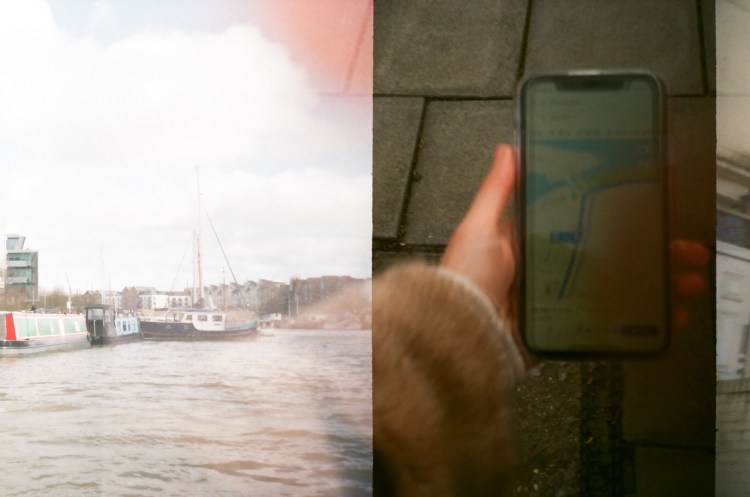
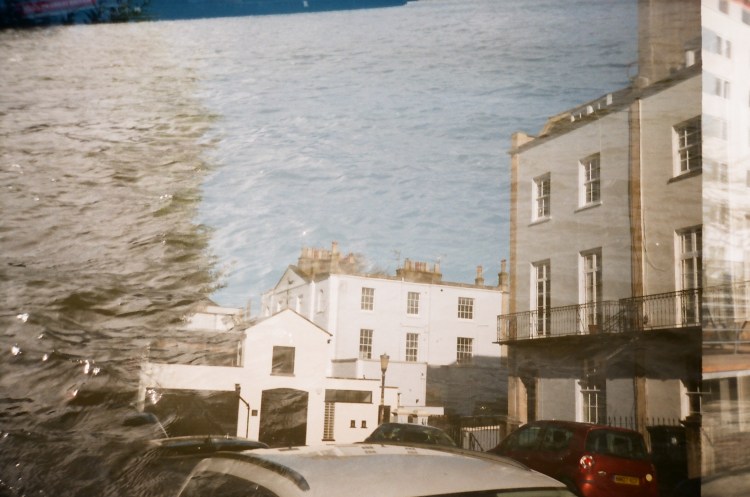
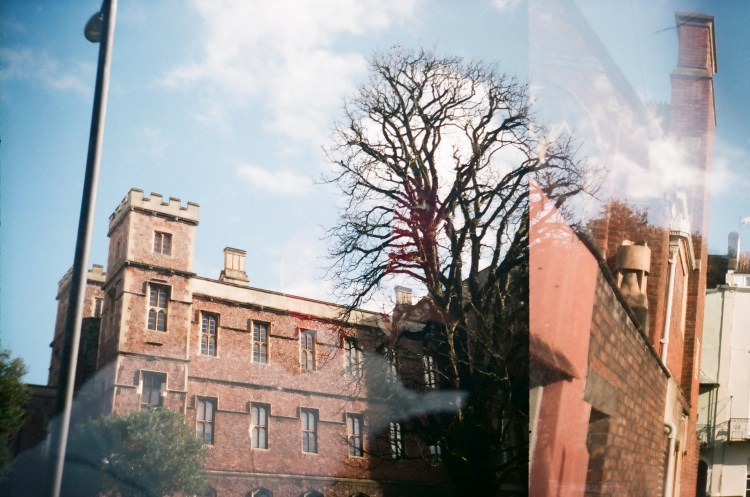
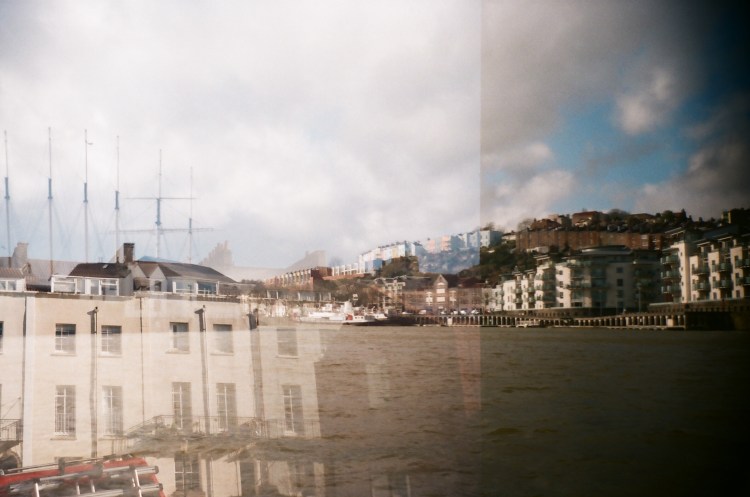
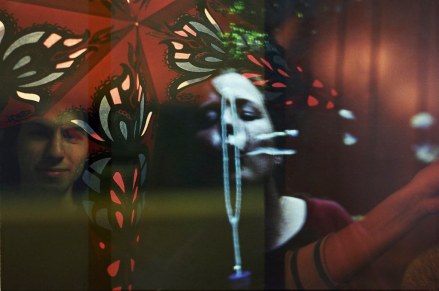
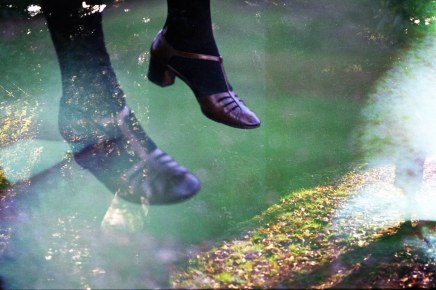
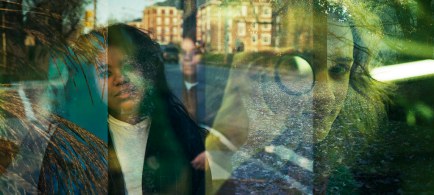
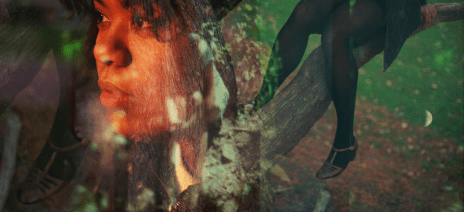
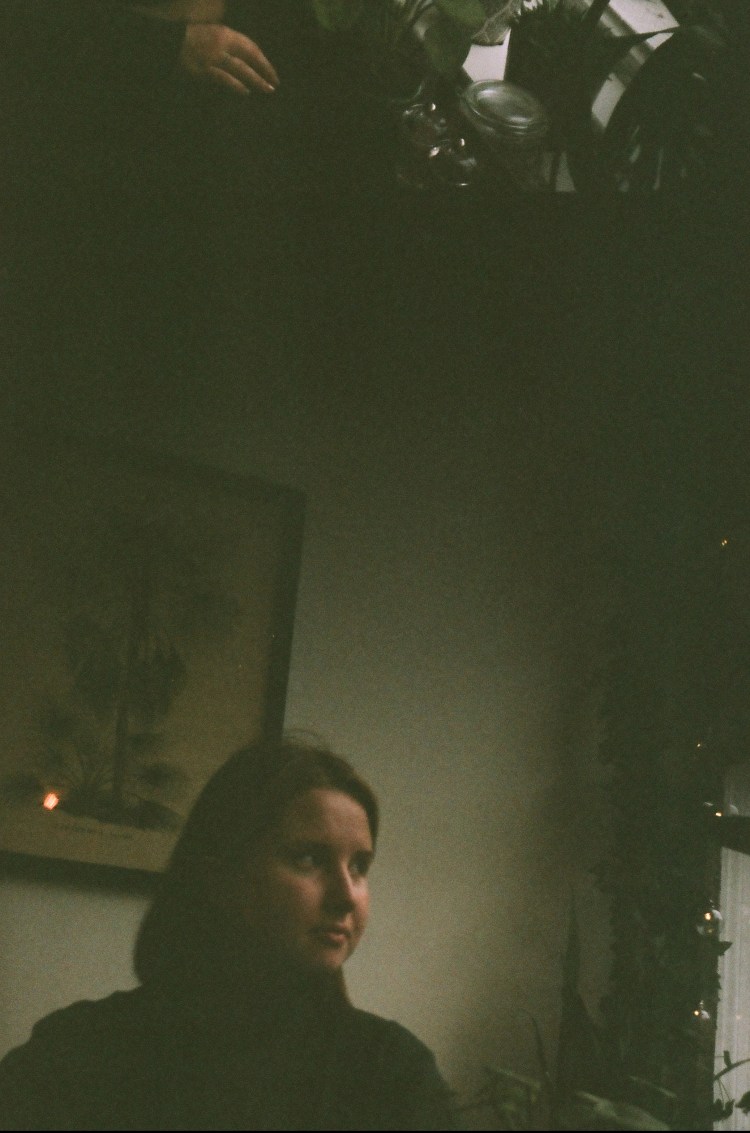
I have shot two rows of film and attempted to rewind them back in order to achieve the triptography effect. These are the 5 images that came out best. I think of these images to be truly successful in picturing thought patterns or dreams when one image suddenly interchanges by another. It can also represent the duality of our perception of the world: the way the things really are, how we see them and on the other hand, the memories or thoughts that these places invoke in our mind.

I was told that I should choose a framework for my image-taking in order to explain the reason why I took specific images. To connect the internal with the external. I was thinking about it and had a few ideas – I really want to do something along the lines of dreams, streams of thoughts and memories (nostalgia). I thought that it would be best to use a film camera for this purpose because due to its nature it is able to produce this effect of something old/memory/unconscious.000005720029

000005720008000005720010000005720012000005720011

Exploring surrealist techniques – Triptography

Surrealism in art, poetry, and literature uses numerous techniques and games to provide inspiration. Many of these are said to free imagination by producing a creative process free of conscious control. The importance of the unconscious as a source of inspiration is central to the nature of surrealism.

Triptography is an automatic photographic technique whereby a roll of film is used three times (either by the same photographer or, in the spirit of Exquisite Corpse, three different photographers), causing it to be triple-exposed in such a way that the chances of any single photograph having a clear and definite subject is nearly impossible. Indeed, finding any edges on the negative itself during the developing process is a nearly impossible task. Typically the developing of such a roll of film is an exercise in automatic technique in and of itself, cutting the film by counting sprocket holes alone, with no regard for the images present on the negative. The results have a quality reminiscent of the transitory period in sleep when one dream suddenly becomes another.


Below are some examples of the triptography photographs that I take as an inspiration for my project.


6478418979_6cd0d8de70_b6478486297_f8861c8afa_b6561776791_8223881eed_bScreenshot 2020-02-27 at 11.57.16


Carl Jung – dream theory research

“Dreams are impartial, spontaneous products of the unconscious psyche, outside the control of the will. They are pure nature; they show us the unvarnished, natural truth, and are therefore fitted, as nothing else is, to give us back an attitude that accords with our basic human nature when our consciousness has strayed too far from its foundations and run into an impasse.” – Carl Jung

Jung saw the mind/body/feelings (or what he called ‘the psyche’) as all working together. Even negative symptoms could be potentially helpful in drawing attention to an imbalance; for example, depression could result from an individual suppressing particular feelings or not following a path that is natural and true to their particular personality. In this way he saw the psyche as a self-regulating system with all psychic contents – thoughts, feelings, dreams, intuitions etc. – having a purpose; he thought the psyche was ‘purposive’.

The basic idea behind Jungian dream theory is that dreams reveal more than they conceal. They are a natural expression of our imagination and use the most straightforward language at our disposal: mythic narratives.  Because Jung rejected Freud’s theory of dream interpretation that dreams are designed to be secretive, he also did not believe dream formation is a product of  discharging our tabooed sexual impulses.


Project review

Last week we delivered our project proposal presentations and got some feedback. From talking to my tutors I realised that I need to do more research about the techniques that I want to use for my project’s output. In order to do so, I’ve looked at some surrealist photographers and the techniques that they’ve used.

Man Ray is most well-known for his surrealist photography and photograms (photographic images made without a camera). You can create a photogram yourself by setting yourself up in a darkroom, placing objects on top of photo paper, and then exposing both the paper and the objects to light. Once you develop the photo paper, you’ll see that there are white shapes where the objects sat. Photograms are an easy way to get acquainted with surreal and abstract “photography” in the darkroom. He also used solarization, double exposures, montages, and combination printing to create works of art that left viewers scratching their heads.

Maurice Tabard (1897-1984) is another notable surrealist photographer. Like Man Ray, he used the techniques of solarization, double exposures and montages to create eerie and unnerving photographic images. He began his work as a portrait, fashion and advertising photographer, while experimenting with surrealist images in his personal work. A room with an eye, a lady who seems to be turning into a tree, and ghostly solarized portraits are only a small portion of the surrealist work he created.

Project research – updated

Through my project I want to use photography as a tool to show the duality of our reality.

Photographer Shannon Taggart is drawn to what she calls “psychological spaces.” She describes these as “invisible realities, like an interior experience you can’t really see,” and relishes the challenge of making visuals to describe them. Taggart says she values photography’s ability to open up new worlds. A straightforward documentary approach seemed inadequate, so she began to combine fine art photography, anthropology, journalism and historical photography to tell the tale.

In her new book, Séance: Spiritualist Ritual and the Search for Ectoplasm, Taggart writes, “Spiritualism developed at a time when photography and other scientific developments were exposing many forces operating beyond human perception. Disease-causing bacteria could be photographed through microscopes; the vastness of the universe was glimpsed through astrophotography; electricity was made visible when placed in contact with photographic materials; X-rays revealed the body’s interior. What else, people wondered, could photography uncover?”

“The crazy photographic history and records of the movement…are bizarre, unsettling, and absurd, but also speak about human love and longing.”

When research or concepts move on, as they soon did in the first decade of the twentieth century, the photograph might no longer represent the object, and it becomes obsolete. Photography then, could be said to generate objects. Not objects in the conventional sense that they exist in the real world, but ‘objects’ that normally have no corporeal presence.  These might be physical phenomena, or, taking the example of Becquerel, however, they might also be scientific concepts. (https://www.fotomuseum.ch/en/explore/still-searching/articles/26935_photography_and_the_invisible)

Photography has been related to a positivist aim since its beginning and its genealogy is generally drawn from the realism of the camera obscura. But when it comes to the sort of photographs usually called “spirit photography” and “fluid and thought photography”, classic theorists like Barthes, Rosalind Krauss and Tom Gunning tend to relate this practice with the magic and the ‘uncanny’ reception that occurred at its very beginnings.

how theories of spectre layers as the basis for the human being.

Barthes – Camera lucida. Barthes considers photography as asymbolic, irreducible to the codes of language or culture, acting on the body as much as on the mind.

The book develops the twin concepts of studium and punctum: studium denoting the cultural, linguistic, and political interpretation of a photograph, punctum denoting the wounding, personally touching detail which establishes a direct relationship with the object or person within it.

According to Balzac’s theory of spectres it would follow that capturing an appearance (in a photograph, in a written description) would correspond to a sort of “extraction” operation. As a realist, Balzac conceived his writing as a mere capturing of the soul of his characters just through the process of depicting the surface of things and bodies. …photography should, in this sense, be a kind of invisible peeling of the soul.

Since then many others have underlined this haunted side of photography, connecting it with the repetition it carries out as a duplicate and the “uncanny” effect produced by it, in the sense Freud had theorized.

((This commensurability is embodied by William Crookes, a physicist and spiritualist, who sums up the concept with which he intends to unify the world of the mind with that of earthly phenomena. He borrows the concept from Sergeant Cox, from whom he quotes:

The theory of Psychic Force is in itself merely the recognition of the fact that under certain conditions, as yet but imperfectly ascertained, and within limited, but as yet undefined, distance from the bodies of certain persons having a special nerve organisation, a Force operates by which, without muscular contact or connection, action at a distance is caused, and visible motions and audible sounds are produced in solid substances..)) That force, Crookes says, “proceeds from this organization by a means yet unknown,” but he identifies these means with “the soul, Spirit or Intelligence,” which, moving the body from within, would also be responsible for its 

The idea of capturing thoughts with the help of mechanical apparatuses had already been set forth in texts such as “Photography Extraordinary” by Lewis Carroll, with less scientific but by no means less significant ambitions. Carroll, in this text from 1855, had already spoken about a machine to “transcribe thoughts,” a “psychographic” machine. A machine similar to a photographic camera that could capture ideas and automatically transcribe them onto a recording surface:

Although this is a literary and fictional text, it shows the way in which the idea of automated register of the immaterial objects, like thoughts or ideas, was creeping as a common fantasy. Photography would play a “natural” role – a medium associated from the very start with an undeniable presence of the world through image and the objectivity of the latter, mainly based on the fact of its use of automated apparatus and its (apparently) non-mediated result.

It was upon this pseudo-passivity that the “white mythology of photography” was fabricated. The medium was then taken for no-medium at all, since it merely registers what is in front of it, making it just a “transfer” from the thing to the paper or plaque. Michael Charlesworth underlined the way Fox Talbot fought to assert the place of photography in the context of that “white mythology,” caring for photography’s ability even to depict things the human eye couldn’t positively have seen. Like Rosalind Krauss, Charles worth also quotes the enigmatic passage of Talbot in The Pencil of Nature, close to the image “A scene in the library.” Talbot speculatively elaborates on the idea that photography can capture some images (radiations, more precisely) impossible for the human eye to see directly:

When a ray of solar light is refracted by a prism and thrown upon a screen, it forms there the very beautiful coloured band known by the name of the solar spectrum.

Experimenters have found that if this spectrum is thrown upon a sheet of sensitive paper, the violet end of it produces the principal effect: and, what is truly remarkable, a similar effect is produced by certain invisible rays which lie beyond the violet, and beyond the limits of the spectrum, and whose existence is only revealed to us by this action which they exert.

Now, I would propose to separate these invisible rays from the rest, by suffering them to pass into an adjoining apartment through an aperture in a wall or screen of partition. This apartment would thus become filled (we must not call it illuminated) with invisible rays, which might be scattered in all directions by a convex lens placed behind the aperture. If there were a number of persons in the room, no one would see the other: and yet nevertheless if a camera were so placed as to point in the direction in which anyone were standing, it would take his portrait, and reveal his actions. For, to use a metaphor we have already employed, the eye of the camera would see plainly where the human eye would find nothing but darkness.

For Talbot, the raw automatism of the device goes further than what human beings can see, and even speculates about its ability to capture “invisible” radiations. The epistemic support for spirit photography can be related to the very beginning of its narrative by its pioneers. Although as for Talbot’s speculation the invisible was not supernatural, but just a kind of nature not possible for the human eye to capture, it is interesting to note how the photography pioneer was dreaming of the ability of the apparatus to enlarge the realm of possibilities beyond human scope.

Madge Donohoe, an Australian journalist of the nineteen thirties, made an album of what she called “skotographs,” or “photographs of thoughts”. The images were almost completely vague and blurred, showing no figure at all for the most part or, at the most, some shadows. For Madge Donohoe, the images were produced just by overlapping the plaque next to her face or head and letting the messenger imprint his message. It could have been her late husband or her late friend sir Conan Doyle. She talked about a kind of telepathic status during the printing of the plaques with no help of any camera. 

But it is certainly not by chance that the telepathic and skotographic images of Madge Donohoe coincide, in time, with the period of the great expansion of Psychology and Psychoanalysis and it is also very likely that the dissemination of the theory of dreams, published by Freud in 1900 and very popular in the nineteen thirties, inspired the interpretative strategy as well as the construction of these images, which would thus reflect the impact on common sense of the ideas concerning a hidden dimension of the mind and the encoded meaning of visual material.

Curiously both deal with blurred images, although in a very different sense and with a very different scope. A same interest in the apparition of a certain truth in the image, allowed by its figurative distortion and abstraction, seems to cut across the different discourses. Just as dreams distort and gain meaning in verbal communication, so too thought photography is a distorted visual representation, the meaning of which being obtained through the reading the subject works through. The problem of (re) cognition as projection is, significantly, referred to by Freud throughout his writings and particularly when he analyses slips of the tongue, misreading and clumsiness, relating these with unconscious desire: “In a majority of cases the text is modified by the reader’s readiness to see something in it that he is prepared to see, some subject that is occupying his mind at the time.”

Chéroux concludes about this projective move that It is precisely because they represent nothing that these images can image anything and whoever looks at them can imagine anything.

Faced with such a-photographic photographs, from which the image of reality is absent, in which there is no reference to the world, the viewer can relax and give free rein to his imagination


Thoughtography is the claimed ability to “burn” images from one’s mind onto surfaces such as photographic film by psychic means.

Bazin and his “Ontology of the Photographic Image.” Bazin underlined that photography obeyed “not an aesthetic but a psychological need to replace reality with its double,”

Bazin points out the mechanical nature of the representation of photography as a fertile ground for belief in “objectivity”:

In spite of any objections our critical spirit may offer, we are forced to accept as real the existence of the object reproduced, actually re-presented, set before us, that is to say, in time and space. Photography enjoys a certain advantage in virtue of this transference of reality of thing to its reproduction.

(https://scholarworks.umass.edu/cgi/viewcontent.cgi?article=1045&context=cpo)


Project Proposal (synopsis)

Through my project I want to use photography as a tool to show the duality of our reality. By using Buddhist Four Noble truths, I want to capture what lies underneath our everyday experiences that holds us back from and leads us to the “path to the enlightenment”. I want to experiment with how you can use photography (and possibly editing) to portray the invisible, the unconscious that’s hidden beneath the appearance of everyday. In my research for the project I will be looking at Ben Highmore’s “Questioning the everyday”, Rudolf Otto’s concept of Numinous and the Freud’s and Marx’s concepts of the unconscious. For Freud and Marx, the everyday is both real and unreal, both actuality and the disguise of actuality, the everyday is not as it appears. Or rather “behind or alongside or underneath the appearance of everyday life lies another actuality.”

Project Research

In order to gain a deeper understanding of how I could depict the invisible with the use of photography through my project, I have looked at a few key theories that are relevant to the theme of my project.

The first and the base theory that I have considered as a part of my research is Questioning the everyday by Ben Highmore.

In his theory Ben suggests that “we all share a condition where our consciousness can be undermined by our unconscious” He states that “For Freud and Marx, the everyday is both real and unreal, both actuality and the disguise of actuality, the everyday is not as it appears. Or rather behind or alongside or underneath the appearance of everyday life lies another actuality”. This very phrase is exactly something that I would like to depict through my project, that there is a subtext behind our everyday actions that drives us do things in a certain way.

“Everyday life is hiding our real nature, the unconscious can be seen only in glimpses. In a repressive realm that censors the unconscious, it suddenly makes its presence felt. It’s all about underlying structures and latent contents” (Highmore). According to Freud’s psychoanalysis theories, our dreams are a sure way to access the true hidden wishes of our subconscious that are often being repressed in our everyday lives due to the society norms.

My initial idea was to incorporate Buddhist Noble Truths as a framework when attempting to depict the duality of our everyday. I have looked at The variety of religious experiences by William James in my research in order to gain a deeper understanding of the topic.

In his text, James quotes Hubert Benoit: “When man studies himself with honest impartiality, he observes that he is not the conscious and voluntary artisan either of his feelings or of his thoughts, and that his feelings and his thoughts are only phenomena which happen to him” (Benoit,1990, p. 29). Which is another way of describing the unconscious drives, but from a religious perspective.


Another famous religious theory is the Numinous by Otto Rudolf.

For Otto, the numinous can be understood to be the experience of a mysterious terror and awe and majesty in the presence of that which is “entirely other” (das ganz Andere) and thus incapable of being expressed directly through human language and other media.

Photography and the optical unconscious – Shawn Michelle Smith and Sharon Sliwinski

“The photographic image is specular and speculative”, it exposes all to occur in the events that are too sudden, too minute or too subtle to be directly observed. Following Walter Benjamin’s descriptions of the optical unconscious, Hayes puts emphasis on the psychoanalytic dimensions of the moment that a photograph is produced, relying on the camera’s ability to capture fleeting or microscopic events. In Benjamin’s 1931 essay “Little History of Photography” he underscores the importance of the camera’s mechanical operations, using the snapshot, slow-motion film, and the microscopic photograph to argue for the mediums ability to reveal occupancies that would ordinarily pass unnoticed in human vision. Despite our efforts to control what photography captures, it doesn’t conform to the will of the subject or operator, containing within it the “tiny shark of contingency” which draws us to its images. “The enlargement of a snapshot does not simply render more precise what in any case was visible. though unclear: it reveals entirely new structural formations of the subject.” For Benjamin it is not the moment of production, but the subsequent moments of developing and looking at photographs, that reveal these new structural formations.

For Freud what is bracketed out in the appearance of everyday life is a forceful realm of desire and fear that can if unchecked, burst through the propriety of daily life. For the most part ‘culture and society’ can be understood as the name given to the checking and censorship that manages the troubling presence of these drives. Propriety and etiquette (the protocols of everyday life) instil a form of life ‘safe’ from untrammelled desires and murderous lusts. The everyday becomes a repressive realm that censors the unconscious.

Understanding Buddhist Four Noble Truths

1.Suffering – dukkha (through our everyday life, the mundane existence) the impermanence of pleasure and things. Picturing the innate characteristic of existence

sensory contact gives rise to clinging and craving to temporary states and things, which is ultimately unsatisfactory and painful. Picture the impermanence of things and how we hold on to them in order to feel “happy”, however it is not true happiness.

2. The cause of suffering – samudaya (the ego, the desire of attachment)

Our day-to-day troubles may seem to have easily identifiable causes: thirst, pain from an injury, sadness from the loss of a loved one. In the second of his Noble Truths, though, the Buddha claimed to have found the cause of all suffering – and it is much more deeply rooted than our immediate worries.

The Buddha taught that the root of all suffering is desire, tanhā. This comes in three forms, which he described as the Three Roots of Evil, or the Three Fires, or the Three Poisons.

The Buddha went on to say the same of the other four senses, and the mind, showing that attachment to positive, negative and neutral sensations and thoughts is the cause of suffering.

The craving keeps us from attaining nirvana and keeps us in the cycle of continuous rebirth – suffering. Only through letting go of the cravings you can reach nirvana

3. Cessation of suffering – nirodha (letting go of attachments and disturbing emotions, cravings)

The Buddha taught that the way to extinguish desire, which causes suffering, is to liberate oneself from attachment.

This is the third Noble Truth – the possibility of liberation.

Someone who reaches nirvana does not immediately disappear to a heavenly realm. Nirvana is better understood as a state of mind that humans can reach. It is a state of profound spiritual joy, without negative emotions and fears.

Someone who has attained enlightenment is filled with compassion for all living things.

After death an enlightened person is liberated from the cycle of rebirth, but Buddhism gives no definite answers as to what happens nex

4. The path – magga (the liberation)

The final Noble Truth is the Buddha’s prescription for the end of suffering. This is a set of principles called the Eightfold Path.

The Eightfold Path is also called the Middle Way: it avoids both indulgence and severe asceticism, neither of which the Buddha had found helpful in his search for enlightenment.

The eight stages can be grouped into Wisdom (right understanding and intention), Ethical Conduct (right speech, action and livelihood) and Meditation (right effort, mindfulness and concentration).

The Buddha described the Eightfold Path as a means to enlightenment, like a raft for crossing a river. Once one has reached the opposite shore, one no longer needs the raft and can leave it behind.

Source: https://www.bbc.co.uk/religion/religions/buddhism/beliefs/fournobletruths_1.shtml


Ideas Session

I came up with the three ideas for my project:


1. Picturing the invisible through photography: the emotion

Four noble truths/the path to the enlightenment

How photography depicts the invisible, does it create a different reality rather than picturing things how they are

I want to use abstract photography to picture our everyday in order to depict the path to the enlightenment through the Buddhist Four Noble Truths

2. Photo project about the integration of a cultural immigrant in the UK

Picturing everyday situations, show the contrasts between the two cultures and the attempts of fitting in, place a person (an immigrant) in the situations where he clearly looks out of place but is dressed in a similar way to the locals in order to fit in

3. Experimenting with photo + text

How text can create a new or contrasting meaning for the photographs.

At our discussion session my first idea got the most votes and it was decided that I should stick with it for my project because it’s the one I think is the most interesting as well. I believe that there is a lot of room for exploration within this idea and I can really experiment with this topic.

Design a site like this with WordPress.com
Get started